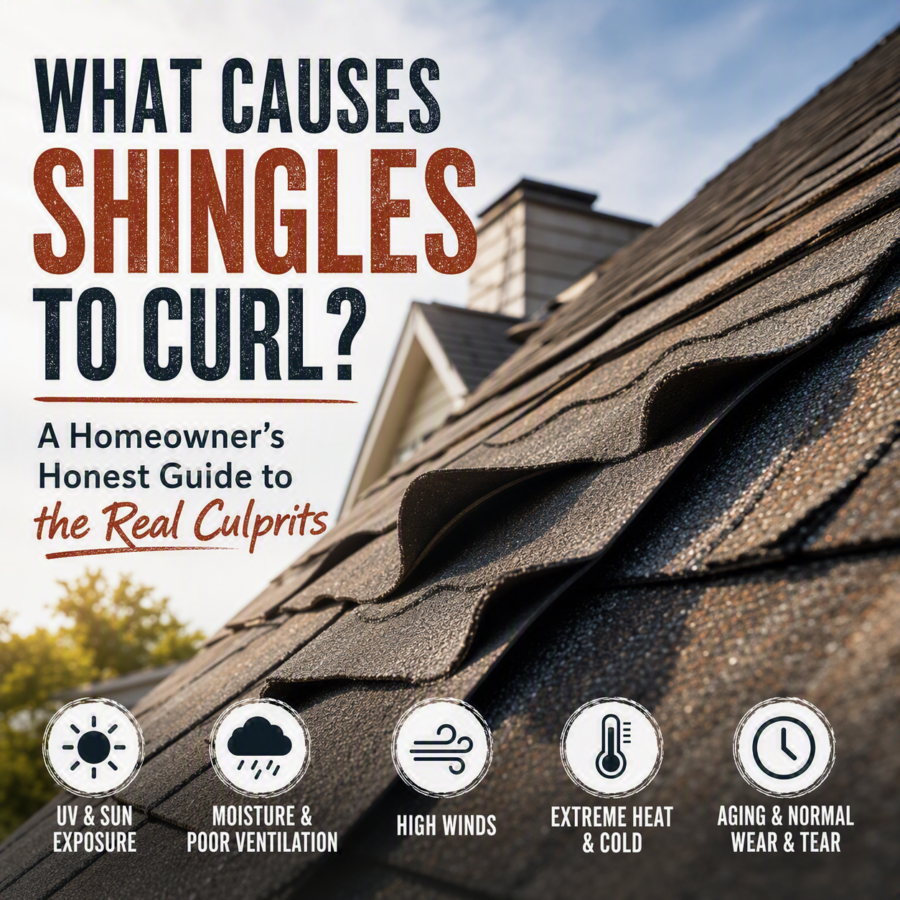
Quick answer: Shingles curl for one underlying reason — the asphalt in them dries out and loses its ability to lie flat against the roof deck. What accelerates that drying is where it gets specific. In roughly 80% of curling cases, the cause traces back to one of three things: poor attic ventilation, natural aging past the 12-year mark, or installation shortcuts the original roofer took. The remaining cases split between trapped moisture, UV damage, storm-related wind uplift, and — rarely — an actual manufacturing defect. This guide walks through all seven causes, how to identify which one is hitting your roof, and whether you’re looking at a repair, a partial replacement, or a full tear-off.
Not sure what’s causing the curling on your own roof? Get connected with a local roofer through RidgeRoofer for a proper inspection.
What Curling Shingles Actually Look Like
Before getting into causes, it’s worth being precise about what you’re seeing on the roof, because different curl patterns point to different problems. Roofers use three terms, and they’re often used interchangeably even though they shouldn’t be.
| Pattern | What it looks like | Most likely cause |
|---|---|---|
| Cupping | Edges of the shingle turn upward while the center stays flat — a shallow bowl shape | Heat and moisture from below, poor ventilation |
| Clawing | Edges stay down but the center bulges upward, or tabs curl downward | Aging asphalt losing its grip on the fiberglass mat |
| General curling | Entire shingle lifts or waves, usually starting at edges and corners | Combination of age, UV exposure, and thermal cycling |
The mechanics behind all three are similar. An asphalt shingle is essentially a fiberglass mat sandwiched between two layers of asphalt, coated with ceramic granules on top. The fiberglass mat is dimensionally stable — it doesn’t shrink. The asphalt does. As the asphalt loses its volatile oils over time, it contracts around the mat, and something has to give. Depending on where the contraction is worst and what’s happening underneath, you get cupping, clawing, or generalized curling.
Now, the seven things that cause that contraction to happen faster than it should.
1. Poor Attic Ventilation (The Biggest Cause by Far)
If your roof is curling and it’s less than 15 years old, ventilation is the first place to look. It’s the single most common cause of premature shingle failure, and the National Roofing Contractors Association has found that inadequate ventilation can cut a shingle’s lifespan roughly in half.
Here’s what’s happening physically. When an attic doesn’t have balanced intake and exhaust airflow, heat and moisture build up under the roof deck. On a hot summer afternoon, a poorly ventilated attic can hit temperatures well above 150°F, essentially baking the shingles from underneath. That heat drives out the asphalt’s flexibility oils on the fast track, and the shingle warps — usually as clawing, because the underside is drying faster than the top.
The building-code standard for attic ventilation, set by the International Residential Code and adopted by every major shingle manufacturer, is 1 square foot of net-free vent area for every 150 square feet of attic floor space, split roughly 50/50 between intake vents (soffits) and exhaust vents (ridge or gable). Some manufacturers accept a 1:300 ratio if a proper vapor barrier is in place. Either way, most homes built before 1990 don’t meet current requirements, and a shocking number of newer roofs get installed without anyone checking.
Two things worth knowing about ventilation and warranty:
- GAF, Owens Corning, CertainTeed, IKO, and Atlas all explicitly require code-compliant attic ventilation to keep their shingle warranties valid. Inadequate ventilation is the number one reason manufacturer warranty claims get denied.
- Powered attic fans combined with ridge vents actually make the problem worse. The power fan short-circuits the airflow — it pulls air in through the ridge vent instead of drawing it from the soffits — which defeats both systems and voids most warranties.
If curling is uniform across the whole roof but the shingles are relatively new, get an inspector into the attic before you touch anything on the roof. Fixing ventilation is far cheaper than replacing shingles that will just curl again.
2. Age and the Slow Death of Asphalt Oils
Asphalt shingles are rated to last anywhere from 15 to 30 years, but the useful life depends heavily on climate, quality, and everything else on this list. What actually kills them is the same thing that kills a rubber band left in a garage for a decade — the oils that give the material its flexibility slowly evaporate. Once those oils are gone, the shingle becomes brittle, shrinks, and starts to curl.
Industry inspectors generally say it’s rare to see curling on shingles younger than 12 years without another cause in play. Once a roof is past that 12-year mark, curling is a signal that the shingle is in its second half of life, and from that point deterioration accelerates. The underlayment underneath is often equally brittle by that stage, which is why patchwork repairs on a 15-year-old roof tend to backfire — you seal one curling shingle and three more curl the following season.
Age-related curling usually appears uniformly across the roof, most visibly on the south and west-facing slopes that took the most sun.
3. Moisture Trapped From Below
This one is often confused with ventilation problems, because they overlap, but it deserves its own category. Moisture from inside the house — humid air rising from bathrooms, kitchens, and laundry rooms — can migrate into the attic through gaps around pipes, wiring, and light fixtures. If a bathroom exhaust fan vents into the attic instead of outside (extremely common in older homes), the problem compounds fast.
When shingles get wet from underneath and dry from the top, they warp — typically into a cupped shape. This kind of curling tends to show up in patches rather than uniformly, and it often lines up with bathrooms, kitchens, or laundry rooms below. If you go into the attic on a cold morning and see condensation on the underside of the roof deck, or dark staining on the sheathing, moisture intrusion from below is a live problem regardless of what the roof looks like.
Fixing it means sealing air leaks between the living space and the attic, ducting bathroom fans to the outside, and — usually — improving ventilation at the same time.
4. UV Radiation and Thermal Shock
The sun does two things to a shingle, and both of them contribute to curling.
First, ultraviolet radiation breaks down the tarry substance that keeps the asphalt supple. UV is the reason south-facing slopes almost always show wear before north-facing ones on the same house. Over years of exposure, UV drives out the same volatile oils that heat does, just from the top down instead of the bottom up. As the top surface dries out, the shingle loses granules (which is why you find dark, sandy debris in your gutters — those are granules that have washed off), and once the granules are gone the asphalt is fully exposed to UV. From there the decline accelerates.
Second, thermal shock. In climates with hot days and cool nights — much of the American South and Southwest in summer, and most of the country during shoulder seasons — a shingle can expand and contract by a measurable amount every 24 hours. Do that a few thousand times and the asphalt loses its ability to stretch. It becomes brittle, cracks form, and the edges lift. Homes in mountain climates and desert regions typically see UV-and-thermal-shock curling earlier than homes in temperate zones.
5. Installation Shortcuts
A well-manufactured shingle installed carelessly will curl years before a mediocre shingle installed correctly. Some of the most common installation mistakes that cause premature curling:
- Nailing outside the manufacturer’s target zone. Shingles have a narrow strip where nails are supposed to land — typically about an inch wide, running horizontally across the shingle. Nails placed too high miss this zone entirely, leaving the shingle to flex with wind. Nails placed too low show through above the next course.
- Wrong nail count. Standard installations use 4 nails per shingle for normal wind zones and 6 nails for high-wind areas. A crew that uses 3 to save time is voiding the warranty and setting the roof up to lift.
- Overdriven or underdriven nails. Nail heads driven too deep cut into the shingle mat. Nails left proud hold the shingle above the deck. Both cause curling within a few years.
- Installing over an existing layer. Layering new shingles over old ones traps heat and moisture between the two layers, and the top layer curls much faster than a single-layer install would. Most modern building codes limit this or ban it outright, but it still happens.
- Cold-weather installation without hand-sealing. Shingles have an adhesive strip that activates in warm sun. Installed below about 40°F without hand-sealing the tabs, they never bond properly, and wind lifts the edges before the seal can form.
- Skipping the starter strip. The first course of shingles at the eaves needs a proper starter row underneath. Without it, the exposed edges of the first course lift immediately.
If a roof starts curling within five to ten years of installation and ventilation checks out, poor workmanship is the most likely explanation. This is why the workmanship warranty from your contractor matters as much as the manufacturer warranty on the shingles.
6. Manufacturing Defects
This is rare, but it does happen. Occasionally a batch of shingles leaves the factory with the wrong asphalt-to-mineral ratio, or with too much tar in the mix, or with insufficient thermal adhesive on the sealant strip. When this occurs, entire sections of a roof can curl within a couple of years of installation, and every affected shingle typically shows the same pattern of failure.
The tell for a manufacturing defect: curling that appears very early (within 2 to 5 years), that affects large contiguous sections identically, and that shows up on multiple slopes regardless of sun exposure. If you suspect a defect, save some of the failed shingles and check the packaging lot numbers if you still have them. Manufacturers do honor these claims when they’re documented, though they’ll often send an inspector first to rule out ventilation and installation.
7. Wind Uplift and Storm Damage
Strong winds can break the adhesive seal between shingle courses without tearing anything visible off the roof. Once that seal is broken, the tab is free to flex with every subsequent gust, and it doesn’t take long for curling to develop. This is especially common on the windward slopes and along ridges, eaves, and rakes.
Hail contributes too, in a slightly different way. A hailstorm that doesn’t obviously destroy a roof will still knock granules loose, exposing the asphalt underneath to UV. Six to eighteen months later, those bare patches often start curling while the rest of the roof looks fine.
One important note: homeowners insurance generally covers sudden and accidental damage from wind or hail, but not gradual wear. If curling starts within a few months of a major storm, get an inspection and file a claim — you may have coverage. If it develops slowly over years, insurance won’t help.
Can You Repair Curling Shingles, or Do You Need a New Roof?
The honest answer: it depends on how much of the roof is affected and how old it is.
For isolated curling on an otherwise healthy roof, individual shingles can be re-sealed. The standard fix is to lift the curled edge, apply roofing cement or asphalt sealant underneath, press the shingle back down, and weight it with a brick for 24 hours while the adhesive cures. Some roofers will warm the shingle with a heat gun first to restore a little flexibility. Done properly, this can buy several years.
Once curling spreads past roughly 10 to 15% of the roof surface, though, spot repairs stop making sense. The shingles have already lost the oils that make them weatherproof. Sealing them down doesn’t restore the flexibility, and the neighboring shingles are almost certainly heading in the same direction. At that stage you’re looking at replacement — and if the roof is over 20 years old, replacement is almost always the smarter call regardless of the percentage curled.
A practical rule of thumb from the field: patching a failing roof usually costs more over five years than replacing it once.
When to Call a Roofer
Book a professional inspection if any of these apply:
- More than a handful of shingles are curling.
- You see granule loss in your gutters or at the base of downspouts.
- Any daylight is visible through the roof deck from inside the attic.
- The roof is over 15 years old, regardless of visible damage.
- There’s been a major windstorm or hailstorm in the last year.
- Interior ceilings show water staining, even faint.
A qualified contractor should be able to tell you within an hour whether the curling is age, ventilation, install error, or storm damage — and whether you’re looking at a targeted repair, a partial replacement, or a full tear-off.
Ready to get eyes on your roof? RidgeRoofer connects you with a local roofer for a free, no-obligation inspection.
Frequently Asked Questions
Are curling shingles always a sign I need a new roof?
Not always, but often. Isolated curling on a young roof can usually be repaired. Widespread curling on a roof over 15 years old almost always means replacement is the better long-term investment.
Can I flatten curled shingles myself?
Physically yes, but only if the shingle is still flexible. Brittle shingles will crack when forced flat. And climbing on a roof with curled shingles is genuinely dangerous — the curled tabs are trip hazards. If you’re not comfortable on ladders and pitched surfaces, it’s not worth the fall risk to save a service call.
How long should asphalt shingles last before they start curling?
A properly installed and ventilated asphalt roof shouldn’t show meaningful curling until at least year 12, and often not until year 15 to 18. Architectural (dimensional) shingles typically outlast three-tab shingles by 5 to 10 years.
Does homeowners insurance cover curling shingles?
Only if the curling is the result of a specific covered event like a windstorm or hailstorm. Gradual wear, age, and ventilation-related damage are not covered under standard homeowners policies.
Will improving my attic ventilation stop the curling?
It will stop new curling if you catch the problem early enough. Shingles that have already curled significantly won’t flatten out on their own — the damage is baked in. But fixing ventilation is the single most important step to protect a replacement roof from repeating the same failure.
Are curled shingles a leak risk right now?
They increase the risk, especially in wind-driven rain. Water can bypass the curled edge, run under the shingle, and hit the underlayment. If the underlayment is old too — which it usually is on a curling roof — you’re one bad storm from an interior leak.
Sources
- National Roof Certification and Inspection Association (NRCIA) — Curling Shingles: A Key Sign of Roof Aging
- International Residential Code, Section R806 — Roof Ventilation Requirements
- National Roofing Contractors Association (NRCA) — Ventilation and Shingle Lifespan Guidelines
- GAF, Owens Corning, CertainTeed, IKO, and Atlas — Published shingle installation and warranty documentation
