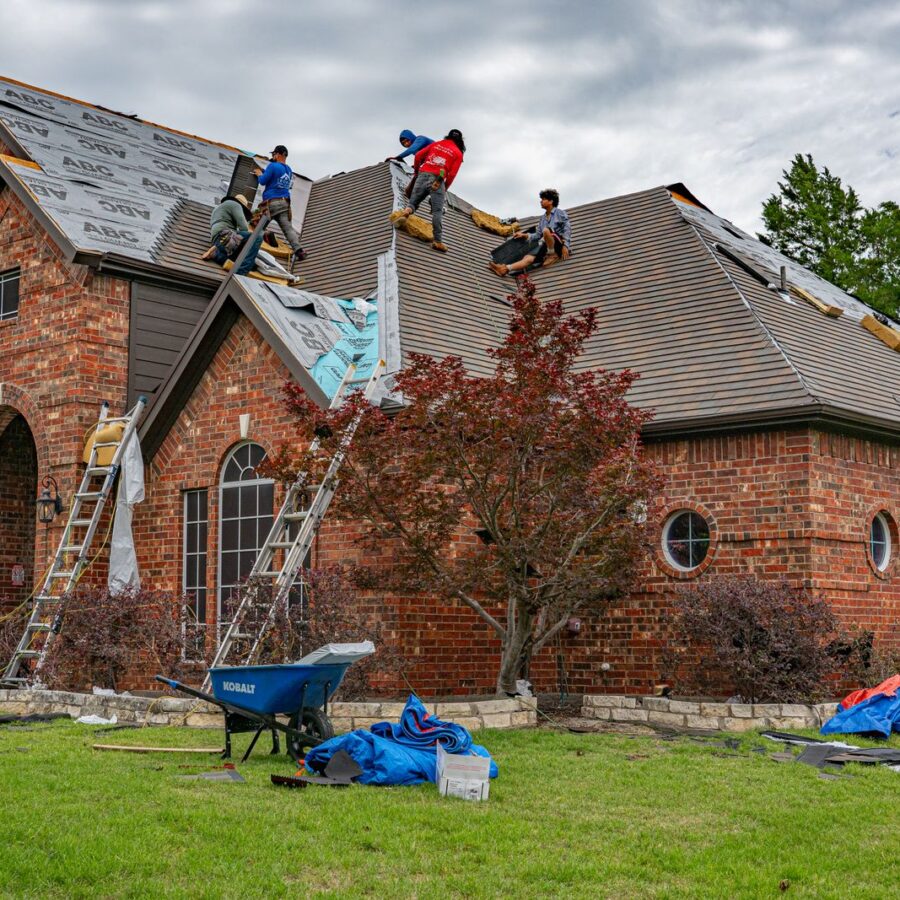
Quick answer: The work on your roof usually takes 1 to 3 days for an asphalt shingle roof on a typical 2,000 to 2,500 square foot home. Metal takes about 3 to 5 days, tile 1 to 2 weeks, and slate 1 to 3 weeks. But the whole process, from your first phone call to a finished and inspected roof, usually takes 4 to 12 weeks. Quotes, the permit, materials and getting onto a crew’s schedule eat most of that time. After a big hailstorm, the wait can stretch to several months.
So when a roofer tells you “we’ll be done in a day,” and your neighbor says it took her all summer, they can both be right. They’re just measuring different things.
Why do people get such different answers?
There are two clocks running on every roof replacement.
The first is the install clock. That’s the time the crew is physically on your roof, tearing off the old shingles and putting on the new ones. It’s short. For most homes, it’s a day or two.
The second is the calendar clock. That starts the day you call your first roofer and stops the day the city signs off on the finished job. It includes getting estimates, picking a contractor, waiting for a permit, waiting for materials, and waiting for an open spot on the crew’s schedule. That clock is where the weeks go.
Most articles on this topic only talk about the install clock, because it’s the number that sounds good. But if your roof is leaking, or your insurance company wants the work done, the calendar clock is the one that matters. This guide covers both.
How long does the actual installation take?
The material you pick has the biggest effect on how long the crew is at your house. Here’s what to expect for a typical single-family home:
| Roofing material | Typical install time | Why |
|---|---|---|
| Asphalt shingles (3-tab or architectural) | 1 to 3 days | Light, fast to nail, and every crew knows them |
| Metal (standing seam or panels) | 3 to 5 days | Panels are measured, cut and fastened to allow for expansion |
| Clay or concrete tile | 1 to 2 weeks | Heavy, set piece by piece, often needs extra underlayment |
| Natural slate | 1 to 3 weeks | Each slate is fitted by hand by a specialist crew |
For asphalt shingles, which cover most American homes, the size of the roof moves the number around too:
| Roof size (asphalt shingles) | Typical install time |
|---|---|
| Under 1,500 sq ft | 1 to 2 days |
| 1,500 to 3,000 sq ft | 2 to 3 days |
| Over 3,000 sq ft | 3 to 5 days |
If you’re still deciding between materials, time is worth adding to the list. A metal roof means a few more days of noise and a longer wait for panels, but you won’t be doing this again for a long time. We compare the two in Shingles vs. Metal Roof: Which One Actually Makes Sense for Your Home?
What happens on each day of a shingle roof replacement?
Here’s what a normal two-day asphalt shingle job looks like, so you know what you’re walking into.
Day 1: Tear-off and prep
- Early morning: The crew shows up, sets tarps over your landscaping, and parks a dumpster or trailer near the house.
- Tear-off (about 3 to 4 hours): The old shingles and underlayment come off. This is the loudest part of the whole job.
- Deck inspection: With the roof stripped to the wood, the crew checks the decking for rot or soft spots. Small repairs take a couple of hours. Bad damage can take a full day.
- Afternoon: Drip edge, ice and water shield in the valleys and along the eaves, and synthetic underlayment go down. By the end of the day, your house is dry again even though there are no shingles yet.
Day 2: Shingles, flashing and cleanup
- Morning to early afternoon: The shingles go on, starting at the bottom edge and working up.
- Flashing: New metal goes around chimneys, skylights, vents and walls. This is where good crews slow down, because this is where roofs leak.
- Ridge cap and vents: The top of the roof is closed off and ventilated.
- Cleanup and walkthrough (late afternoon): The crew sweeps the yard and driveway with a big magnet to pick up nails, hauls off the debris, and walks the job with you.
What you should do before Day 1: Move your cars out of the driveway. Take pictures and mirrors off the walls on the top floor, since the hammering shakes the house. Cover anything stored in the attic, because dust and bits of old shingle will fall through. Keep pets and kids inside or away from the house. You don’t have to leave, but it will be loud from about 7 a.m. on.
What adds extra days to the job?
The numbers above are for a simple roof on a normal day. These are the things that push them up:
- A steep roof. Anything steeper than an 8/12 pitch (8 inches of rise for every 12 inches across) adds roughly 25 to 50 percent to the job. A very steep 12/12 roof can take close to twice as long, because the crew needs harnesses, roof jacks and more time to move safely.
- More than one old layer. If someone put new shingles over old ones years ago, the tear-off takes about twice as long. Most building codes allow no more than two layers, so the extra layer has to come off.
- A complicated roof. Each dormer adds about 2 to 4 hours. Each valley adds 1 to 2. Chimneys and skylights add flashing work.
- Rotten decking. Nobody can see this until the old shingles are off. One industry estimate puts it at about 1 in 5 jobs running 1 to 2 days long because of damaged wood underneath.
- Rain. Crews generally won’t tear off a roof if there’s a real chance of rain, and many won’t start at a 30 percent forecast or higher. One rainy day usually costs one day, sometimes two if the wood has to dry.
A good contractor will warn you about the first three before they start. The last two are nobody’s fault. Just leave some room in your plans for them.
Not sure how long your roof will take? Get matched with a local roofer near you for a free inspection and a written estimate with a realistic timeline.
How long before a roofer can actually start?
This is the calendar clock, and it’s where most of your time goes. Here’s how the waiting usually breaks down:
| Step | Typical time | What slows it down |
|---|---|---|
| Getting your estimate | 1 to 2 weeks | Busy season, roofers who don’t call back |
| Permit | Same day to 2 weeks | Material changes, busy cities, hurricane zones |
| HOA approval (if you have one) | 10 to 21 days | Color and material rules, monthly board meetings |
| Materials arriving | A few days to 8 weeks | Special colors, metal, tile, slate |
| A spot on the crew’s schedule | 2 to 3 weeks off-season, 6 to 8 weeks in peak season | Storms, spring and fall rush |
Some of these overlap. Your roofer can pull the permit while the shingles are on order. That’s why a realistic total is about 3 to 4 weeks at best and 8 to 12 weeks in a busy season.
Permits
A full roof replacement almost always needs a permit. In many towns, a like-for-like reroof (shingles off, shingles on) is approved over the counter the same day. If you’re switching materials, say from shingles to tile, expect 1 to 2 weeks of plan review. Some places run much longer. Busy markets can take up to 6 weeks, and Miami-Dade County is known for 3 to 6 week permit timelines because of its hurricane rules.
Your roofer should pull the permit, not you. If a contractor asks you to pull it yourself, that’s often a sign they aren’t licensed in your town.
Materials
Lead times depend a lot on what you pick:
| Material | Typical lead time |
|---|---|
| Standard asphalt shingles | 1 to 7 days |
| Architectural shingles | 3 to 10 days |
| Cedar shake | 2 to 3 weeks |
| Standing seam metal | 2 to 4 weeks |
| Clay or concrete tile | 3 to 6 weeks |
| Slate | 4 to 8 weeks |
One thing that catches people out: the color matters, not just the product. The popular colors of a shingle line are usually in stock. A less common color can add a week or two while the supplier waits on a shipment. If you’re in a hurry, ask your roofer which colors they can get this week.
Material choice changes the price as much as the timeline. For current numbers, see How Much Does a New Roof Cost in 2026? and How to Choose the Right Roofing Material for Your Home.
How long does it take after a storm or insurance claim?
Storm damage changes the whole timeline, and not in your favor.
The first 24 to 48 hours: If water is getting in, a roofer can usually tarp the damaged area the same day or the next. Do this even if the full replacement is weeks away. Your insurance policy expects you to stop the damage from getting worse.
The insurance part: Your insurer has to send an adjuster, agree on the damage, and approve the claim before most roofers will start. In a normal week, the adjuster visit and approval can happen within about a week. After a big storm, adjusters are swamped too. Many states have prompt-payment laws that set deadlines. Texas, for example, generally gives insurers 15 days to acknowledge a claim, 15 business days after they have everything they asked for to accept or deny it, and 5 business days to pay once they accept. Those deadlines can be extended after a major weather disaster.
The backlog: This is the part nobody warns you about. When hail hits a whole neighborhood, every roof on the street needs work at the same time. Local roofers get booked months out. After an April 2026 hailstorm in Republic, Missouri, some homeowners waited nearly four months for their replacement to start. The work on the roof itself then took three days.
Typical storm timelines look like this:
- Small, local storm: about 2 to 4 weeks from damage to finished roof
- Major storm hitting a whole area: 4 to 8 weeks or more, sometimes several months
Don’t let the wait push you into signing with the first truck that pulls up to your house. Out-of-town “storm chasers” show up after every big hailstorm, promise to start right away, and are often gone by the time a leak shows up. Get the tarp on, file the claim, and take a few days to check who you’re hiring. We walk through the whole claim process in Should You File a Roof Insurance Claim? Read This Before You Call.
Does the time of year change how long it takes?
Yes, in two ways: how fast you can get on the schedule, and how fast the crew can work once they’re on your roof.
Spring and fall are the busy seasons in most of the country. The weather is good for roofing and storm season is in full swing, so crews book up fast. Expect the longest waits.
Summer is fine for the shingles, but heat slows people down. In very hot stretches, crews start at dawn and stop early to avoid heat exhaustion, which can turn a one-day job into two.
Winter is often the fastest time to get scheduled, especially in warm states. In cold states, there’s a catch. Shingles have a strip of sealant that bonds each shingle to the one below it, and that strip needs sun and warmth to activate. GAF, one of the biggest shingle makers in the US, recommends installing at 40°F or warmer. Crews can still roof in colder weather, but they have to hand-seal each shingle with dabs of roofing cement, which takes longer. Below 40°F, shingles also get stiff and can crack, so crews handle them more carefully.
If your roof isn’t leaking and you can wait, late fall in the South or an early spring booking in the North can get you a crew with fewer delays.
Is a one-day roof replacement a good sign or a red flag?
It can be either.
A small, simple roof with one layer and a big, experienced crew can really be finished in one long day, around 8 to 10 hours. A crew of five or six people can do a 2,000 square foot shingle roof in a day or two. That’s normal.
What you want to watch for is a roofer who promises one day on a roof that clearly isn’t simple: steep, lots of angles, two old layers, a chimney and skylights. Speed on a roof like that usually means something got skipped. The common shortcuts are:
- Not replacing rotten decking, or not looking for it at all
- Reusing old flashing around the chimney and walls
- Leaving out ice and water shield in the valleys
- Too few nails per shingle, which can void the manufacturer’s warranty
Ask these questions when you get your estimate:
- How many people will be on the crew, and how many days do you expect this to take?
- What happens if you find rotten decking, and what does each sheet cost to replace?
- Will you replace the flashing, or reuse it?
- Who pulls the permit, and who schedules the final inspection?
A good roofer answers all four without hesitating.
How can you keep your roof replacement on schedule?
You can’t control the weather or a hailstorm, but you can take a lot of the slack out of the calendar clock:
- Start getting estimates early. If your roof is 15 to 20 years old and showing wear, like granules in the gutters or curling shingles, start calling before it leaks. You’ll have more choice of roofers and dates.
- Pick your shingle and color quickly. Ask which colors are in stock locally.
- Get the start date in writing. A real estimate should list an expected start week, not “soon.”
- Send your HOA paperwork right away if you have one. It’s often the slowest step.
- Book in the off-season if the roof isn’t urgent.
- Clear the driveway and yard the night before so the crew can start on time.
- Understand the payment schedule before you sign. Never pay in full up front. Our guide on how to pay a roofer covers what’s normal.
What happens after the crew leaves?
The shingles are on, but the job isn’t quite finished:
- Final inspection: If your town requires one, it usually happens within about 3 to 5 business days after the roofer requests it. Some towns also inspect the deck nailing partway through the job.
- Dumpster pickup: Usually 1 to 2 business days after the work is done.
- Warranty registration: Many manufacturer warranties have to be registered within a set time after installation. Ask your roofer who registers it and get a copy.
- Final payment: Hold the last payment until the final inspection passes and you’ve walked the roof and yard with the contractor.
Keep your permit, inspection sign-off, invoice and warranty paperwork together. You’ll want them if you sell the house or ever file an insurance claim.
Frequently asked questions
Can a roof be replaced in one day?
Yes, if it’s a small, simple asphalt shingle roof with one layer and a full crew. Most average-size homes take 1 to 2 days. Complicated or steep roofs take longer.
Do I need to be home during a roof replacement?
No, but you should be reachable. The crew may find rotten decking and need your OK to replace it. Many homeowners stay home and work from a quiet room, or leave for the loudest part, which is the tear-off on the first morning.
Can I live in my house while the roof is being replaced?
Yes. The crew only opens up as much roof as they can cover again the same day, so your house stays dry overnight. Expect noise, some dust in the attic, and nails in the yard until cleanup.
Can roofers replace a roof in the rain or in winter?
Not in the rain. Crews won’t tear off a roof when rain is likely. In winter, they can work if it’s dry, but below 40°F shingles need to be hand-sealed, which takes longer.
How long does a roofing permit take?
Anywhere from the same day to about 2 weeks in most places. Switching materials, busy cities and hurricane zones can take longer, up to 6 weeks in some markets.
How long does a metal roof take to install?
About 3 to 5 days on the roof, plus 2 to 4 weeks to get standing seam panels made and delivered.
How long after insurance approval can the work start?
If your roofer isn’t backed up, often within 1 to 3 weeks, mostly waiting on materials and the permit. After a major storm, it can be months because of the backlog.
The bottom line
The roofing part is fast. Most shingle roofs go on in a day or two. The waiting is what takes time: estimates, permits, materials, and a spot on a good crew’s schedule. Plan for a month or two, longer after a storm, and give yourself a cushion for rain and surprises under the old shingles.
If you want a realistic timeline for your own roof, the fastest way to get one is a free inspection from a local roofer who can tell you what’s under your shingles and when they can start. Get matched with a local roofer near you.
Sources
- RoofVista: How Long Does a Roof Replacement Take? Complete Timeline Guide
- MrRemodel: How Long Does a Roof Replacement Take? True 2026 Timelines
- Illinois Roofing Institute: How to Determine a Roofing Project Timeline
- Do I Need a Permit: Complete Guide to Roof Replacement Permits (2026)
- Extreme Roofing: Miami-Dade Roof Permit Timeline 2026
- GAF: Cool Weather Roofing Tips for Installing Shingles
- KY3: Springfield roofing crews fight backlogs to catch up on storm damage repairs (August 2026)
- Reyes Law: Prompt Payment Rules Texas Insurers Must Follow